1. Introduction: South Africa’s Multilingual Reality
South Africa is one of the most linguistically diverse nations on earth. With 11 official languages recognised by the Constitution - including Zulu, Xhosa, Afrikaans, English, Sepedi, Setswana, Sesotho, Tsonga, Swati, Venda, and Ndebele - navigating professional communication across language barriers is not a luxury; it is a necessity. For businesses, government departments, NGOs, legal firms, medical institutions, and conference organisers, finding reliable translation companies in South Africa is critical. Poor translation does not merely cause confusion; it can result in legal liability, reputational damage, or the complete breakdown of important negotiations. The demand for professional language services has grown dramatically over the past decade, driven by South Africa’s expanding role in African continental trade, increased foreign investment, and the growing formalisation of indigenous languages in public life. Whether you are translating a legal contract, organising an international conference, or localising a website for a multilingual audience, you need a translation partner who understands the South African context from the inside out. This article explores what makes a top-tier translation company, what services you should expect, and why Ukwazi Conference Interpreters and Translators, based in Pretoria, stands among the most trusted language service providers in the country.
2. What Makes a Great Translation Company?
Not all translation companies in South Africa offer the same level of quality. Here are the key criteria that separate excellent providers from mediocre ones:
Qualified, Native-Language Translators
The best translation agencies employ translators who are native speakers of the target language and hold formal qualifications in linguistics, translation studies, or a relevant subject-matter field. A qualified legal translator, for example, should understand both the linguistic and legal frameworks of both countries involved.
Subject-Matter Expertise
General fluency is not enough. A contract for a mining company requires knowledge of South African mining law. A medical report requires understanding of clinical terminology. Look for companies that can demonstrate expertise across a range of sectors, including legal, medical, financial, technical, and academic translation.
Quality Assurance Processes
Reputable translation companies follow a three-stage process: translation, editing, and proofreading (TEP). This ensures that the final document is not only linguistically accurate but also stylistically appropriate and free of errors.
Confidentiality and Data Security
Professional translators work under strict non-disclosure agreements. If you are sharing sensitive legal documents, medical records, or business strategies, your translation partner must guarantee confidentiality.
Technology Integration
Leading agencies use Computer-Assisted Translation (CAT) tools and maintain translation memories to ensure consistency across large projects and to reduce costs on repeat content. However, human oversight remains essential - machine translation alone is never sufficient for professional documents.
Turnaround Time and Responsiveness
Deadlines matter. A reliable translation company will provide realistic turnaround estimates and communicate proactively if any challenges arise. Look for companies with a track record of on-time delivery.
3. The Languages of South Africa: A Unique Challenge
South Africa’s linguistic landscape is extraordinary. According to Statistics South Africa, isiZulu is the most widely spoken home language (approximately 25% of the population), followed by isiXhosa (approximately 16%), Afrikaans (approximately 12%), and English (approximately 10%). In practice, this means that a company headquartered in Johannesburg may need to communicate with employees, customers, and partners in multiple languages simultaneously. Government communications are constitutionally required to be inclusive. Large conferences routinely require simultaneous interpretation into four or more languages. This complexity is precisely why professional translation companies in South Africa with deep local knowledge are irreplaceable. An agency that understands the cultural nuances of Sesotho or the dialectal variations within Afrikaans will produce translations that feel natural and appropriate - not stilted, robotic, or culturally tone-deaf. Key language pairs commonly required in South Africa include: English ↔ Afrikaans English ↔ isiZulu English ↔ isiXhosa English ↔ Setswana English ↔ Sesotho English ↔ Sepedi (Northern Sotho) Afrikaans ↔ isiZulu English ↔ French (for African continental business) English ↔ Portuguese (for Mozambique and Angola trade) English ↔ Mandarin (for South Africa-China business relations)
4. Types of Translation Services Available in South Africa
The umbrella of “translation services” covers a wide range of specialised offerings. Understanding these distinctions will help you identify exactly what your organisation needs.
Document Translation
This covers the written translation of any text-based material: legal contracts, government certificates, academic transcripts, financial reports, marketing materials, technical manuals, and more. Quality document translation requires not only linguistic skill but also formatting expertise - the translated document should look and feel identical to the original in terms of layout and presentation.
Interpretation Services
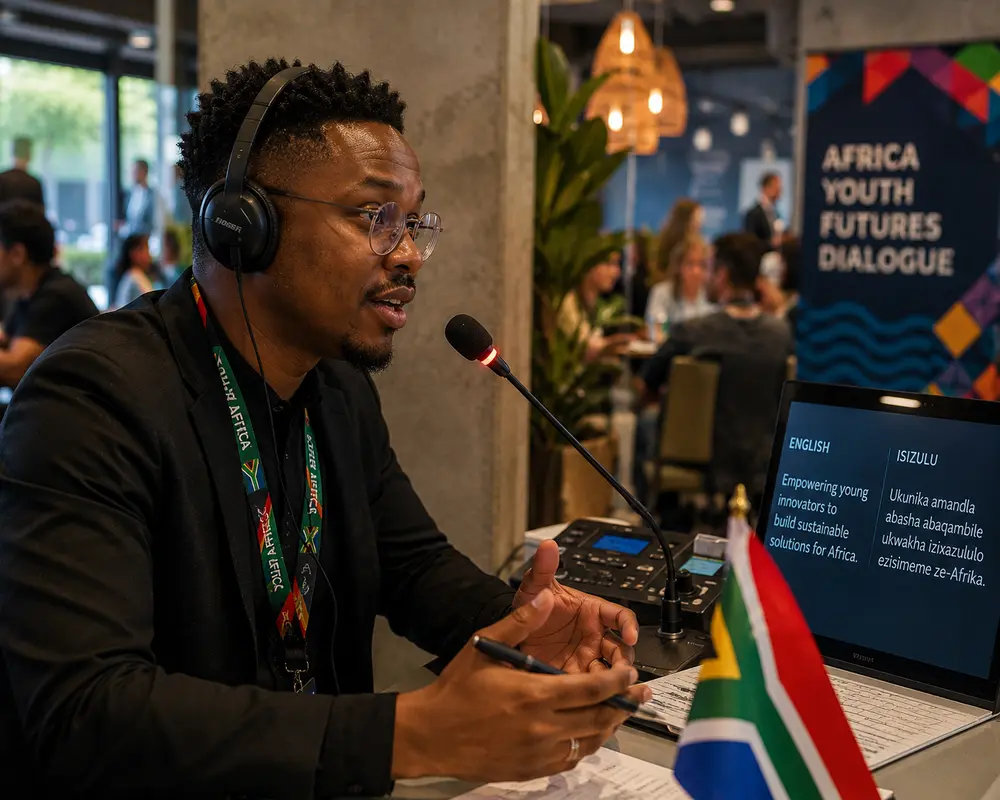
Interpretation involves the real-time conversion of spoken language. There are two primary modes: Simultaneous Interpretation: The interpreter renders the speech into the target language in real time, typically from a soundproof booth using specialised equipment. This is the gold standard for large international conferences. Consecutive Interpretation: The speaker pauses after sections of speech, and the interpreter then translates. This is suitable for smaller meetings, legal proceedings, and medical consultations.
Localisation
Localisation goes beyond translation. It adapts content culturally - adjusting idioms, examples, currency references, date formats, and cultural assumptions to be appropriate for the target audience. This is particularly important for marketing materials, websites, and software.
Transcription and Subtitling
Some language service providers offer transcription of audio and video content, as well as subtitle creation for films, training videos, and corporate content.
Certified Translation
Certain documents - particularly for legal, immigration, or official government purposes - require a certified translation bearing the translator’s declaration that the translation is accurate and complete. Not all translation companies offer certified translations; it is essential to confirm this capability when required.
5. Document Translation: Getting It Right
Of all language services, document translation is the most frequently requested. Here is what to expect from a professional provider: Initial Assessment: The company will review your document to assess complexity, subject matter, and length, and will provide a quote based on word count or page count. Assignment to a Specialist: Your document will be assigned to a translator with expertise in the relevant field - not simply the first available general translator. Translation, Editing, and Proofreading: The TEP process ensures multiple sets of expert eyes review the document before delivery. Formatting Preservation: A quality agency will return your document in the same format as the original, whether that is a Word file, PDF, or PowerPoint presentation. Delivery and Revisions: You should receive a final document within the agreed timeframe, with the opportunity to request revisions if anything does not meet your expectations.
6. Interpretation vs. Translation: Understanding the Difference
A common source of confusion is the difference between translation and interpretation. Understanding this distinction helps you request the right service: Both require exceptional bilingual proficiency, but they are distinct skills. Many professional translators do not interpret, and vice versa. An agency that offers both - and has dedicated teams for each - is especially valuable for organisations that regularly engage in both written communication and live multilingual events.
7. Why Location Matters: Choosing a Company Near You
While remote translation can be delivered anywhere, there are compelling reasons to choose a translation company that is geographically close to you - particularly in Gauteng and Pretoria: On-Site Interpretation: For conferences, legal hearings, and medical appointments, your interpreter needs to be physically present. A local company can mobilise interpreters quickly and cost-effectively. Equipment Delivery and Setup: Conference interpretation requires booths, receivers, and PA systems. A Pretoria-based provider avoids costly long-distance logistics. Local Legal Knowledge: For certified translations used in South African courts or government departments, a locally based translator is far more likely to understand the specific requirements. Cultural Familiarity: Translators who live and work in Gauteng understand the local business culture, the mix of languages spoken on the ground, and the specific conventions of South African professional communication.
8. Industry Standards and Certifications to Look For
When evaluating translation companies in South Africa, look for the following indicators of quality and professionalism: SATI Membership: The South African Translators’ Institute (SATI) is the professional body for translators in the country. SATI accreditation indicates that a translator has met a formal standard of competence. Visit SATI at www.translators.org.za ISO 17100 Compliance: This international standard specifies requirements for translation service providers, covering translator qualifications, process, and quality assurance. FIT Membership: The International Federation of Translators (FIT) connects professional translation organisations globally. Visit FIT at www.fit-ift.org AIIC Standards for Interpreters: The International Association of Conference Interpreters (AIIC) sets global standards for conference interpretation. Visit AIIC at www.aiic.net
9. Ukwazi Conference Interpreters and Translators: Your South African Partner
Ukwazi Conference Interpreters and Translators, headquartered at 39 Squirrel Avenue, Theresa Park, Pretoria, is a professional language services company serving clients across South Africa and beyond. Ukwazi offers a comprehensive suite of services designed to meet the full spectrum of multilingual communication needs: Comprehensive Document Translation: Ukwazi provides expert translation of documents, books, reports, articles, presentations, and website content. Every translation is handled by qualified professionals who ensure accuracy, cultural relevance, and fidelity to the original intent. Interpretation Services: Specialising in consecutive, simultaneous, and virtual interpretation, Ukwazi’s skilled interpreters facilitate clear and effective communication in real time - whether in a boardroom in Sandton, a government hall in Tshwane, or a virtual meeting platform. Conference Equipment Rentals: Ukwazi supplies high-quality conference interpretation equipment, including interpretation booths, receiver systems, Public Address (PA) systems, and full AV setups. This end-to-end service means clients do not have to coordinate between multiple vendors. Ukwazi’s deep roots in Pretoria and Gauteng, combined with its professional standards and client-centred approach, make it one of the most reliable translation companies in South Africa for organisations requiring both quality and convenience. Contact Ukwazi: - Phone: 012 542 5977 - WhatsApp: +27 84 406 2830 - Website: www.ukwazitranslations.co.za - Address: 39 Squirrel Avenue, Theresa Park, Pretoria, 0182
10. How to Request a Quote
Getting a quote from a professional translation company is straightforward. To speed up the process, have the following information ready: The source language (the language your document is currently in) The target language (the language you need it translated into) The document type (legal contract, certificate, report, etc.) The approximate word count or page count Your required turnaround time Any specific formatting requirements For interpretation services, also prepare: - The date, time, and duration of your event - The venue or virtual platform being used - The number of languages required - The expected number of participants - Whether interpretation equipment is needed
11. Frequently Asked Questions
Q: How long does professional document translation take? A: Turnaround time depends on the length and complexity of the document. A standard page (250 words) typically takes one to two working days when following a full TEP process. Urgent services are often available at a premium. Q: What is the difference between certified and sworn translation? A: A certified translation includes a signed declaration by the translator confirming accuracy. A sworn translation is performed by a translator who has taken a legal oath and is recognised by courts or notaries. Requirements vary by country and institution. Q: Can I use machine translation for professional documents? A: Machine translation tools like Google Translate or DeepL can be useful for getting the gist of a document, but they are not suitable for professional, legal, or official documents. Errors in machine translation can have serious consequences. Always use a qualified human translator for important materials. Q: Do I need an interpreter or a translator for my conference? A: If your event involves live, spoken communication across languages, you need an interpreter. If you need written materials - such as event programmes, presentations, or reports - translated in advance, you need a translator. Many events require both. Q: Are your services available outside of Pretoria and Gauteng? A: Yes. While Ukwazi is based in Pretoria, the company serves clients throughout South Africa and can coordinate virtual interpretation for online events anywhere in the world.
12. Conclusion
South Africa’s multilingual landscape creates both a challenge and an opportunity. Organisations that invest in professional translation and interpretation services are better positioned to communicate effectively with diverse audiences, comply with legal requirements, and build trust across language barriers. When searching for translation companies in South Africa, prioritise experience, qualifications, local knowledge, and a full-service offering. Ukwazi Conference Interpreters and Translators in Pretoria brings all of these qualities together under one roof - from expert document translation to simultaneous conference interpretation and professional equipment rental. Get in touch with Ukwazi today to discuss your language service needs and receive a tailored quote.
Further Reading and Authoritative Resources
South African Translators’ Institute (SATI) Pan South African Language Board (PanSALB) International Federation of Translators (FIT) AIIC – International Association of Conference Interpreters ISO 17100: Translation Services Standard Ukwazi Conference Interpreters and Translators | 39 Squirrel Avenue, Theresa Park, Pretoria, 0182 | Tel: 012 542 5977 | WhatsApp: +27 84 406 2830 | www.ukwazitranslations.co.za